


On April 4, 2025, Tracy Chapman’s iconic 1988 debut album makes a triumphant return in a meticulously crafted vinyl reissue, to celebrate its 35th anniversary. This project, a labor of love initiated by Chapman herself in 2022, reflects her dedication to preserving the album’s legacy, both in its original sound and aesthetic.
Collaborating with longtime producer David Kershenbaum and audio engineer Bernie Grundman, they have ensured that every aspect – from sound quality to artwork – honors, matches or exceeds the iconic original 1988 pressing. With its stunning artwork and added international lyrics insert, this reissue promises to resonate with both longtime fans and new listeners alike, offering a fresh way to experience an enduring masterpiece.
Read the official PR telling about the behind the scenes of the vinyl re-release (published on March 31, 2025)
On April 4, 2025, a classic returns; the vinyl reissue of Tracy Chapman, the singer-songwriter’s multiplatinum 1988 debut album.
In the works since 2022, Chapman approached the record label to consider re-releasing the vinyl to mark a major milestone, the 35 th anniversary of its first release. Having heard from record collecting friends that the album was hard to find in good condition, Chapman set out to make a high-quality reissue, faithful to the original in the sound of the vinyl and the look of the package.
Assisting with the reissue was David Kershenbaum, the original producer of the album. His production credits include Joan Baez, Duran Duran, Joe Jackson, Cat Stevens and Supertramp, as well as Chapman’s follow-up albums Crossroads (1989) and Telling Stories (2000). Prior to this project, he had also helped her assemble the 2015 Greatest Hits compilation. They were longtime colleagues who had also become lifelong friends.
“The two of us have stayed in touch over the years,” says Chapman. “He has a combination of technical ability, emotional intelligence and a great sense of humor. The studio can be an intimidating place, but he made me feel comfortable.”
Undertaking this project with Chapman, the multiple Grammy-winning producer Kershenbaum says, “We work well together. We always did. This was a challenge, but we were on the same page: it had to be great; it had to be true to form.”
A search of the Warner Music Group archives uncovered an original Bob Ludwig master, which they brought to veteran audio engineer Bernie Grundman in Los Angeles to create a new lacquer.
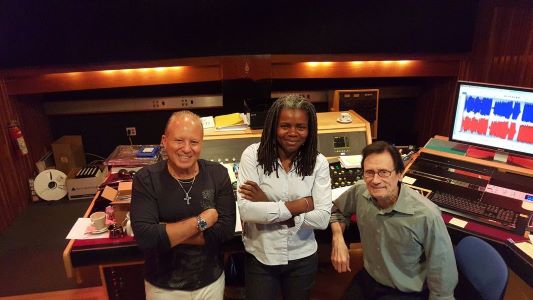
“Our one requirement,” continues Kershenbaum, “was that this reissue sound as good or better than the original pressing. Over the years, technology changes, the vinyl changes, the process of stamping records changes. We worked hard, going back and forth comparing the original vinyl record with what we were doing. I had a process where I recorded each test pressing as well as the original onto my studio system and A/B’ed them. They got pretty close very quickly, but there were some things we wanted to correct, and we spent a lot of time doing that. Tracy was very, very careful. We don’t want to disappoint people. It wasn’t the quickest process, but I think the quality will show.”
With the test pressings approved at the end of 2023, the process for completing the artwork became the focus. To that end, Spark Los Angeles handled printing the inner sleeve, ably selecting a paper and ink combination to address color shift issues that can occur due to optical brighteners found in today’s paper stock. The highly regarded Optimal Media in Germany created a new die for the cardboard cover to match the size and scale of the original image. Chapman wanted the evocative close-up cover portrait taken by New York City photographer Matt Mahurin to be reproduced so as not to distort the image in any way; the same went for the beautiful inner sleeve shot of a shyly smiling Chapman.
The resulting package is itself a work of art, not something to be tucked away on a shelf, an album-cover image that has become almost as iconic as the music itself. Not to be confused with the recent Argentinian bootleg, this 35th anniversary edition package also includes an insert that had only been included on international editions of the original album, with the lyrics translated into French, German, Italian and Spanish.
The international audience was key to Chapman’s initial success. There from the beginning of Chapman’s career, David Bither, currently president of Nonesuch Records, was at that time head of international at Elektra, her longtime label, and she asked him to consult on this reissue. As Bither says,
“I vividly recall first hearing Tracy’s debut recording in a staff meeting at Elektra. You could tell from the look on the face of Bob Krasnow, the chairman of Elektra, that he was about to play something very special. Tracy’s voice and her songs were completely original and so powerful, with a timelessness that harkened back to Elektra’s roots as a folk music label but with a currency that was relevant that very day – while sounding like nothing else in the contemporary marketplace. Krasnow knew, and he was very supportive of Tracy from the beginning. Tracy’s first performances upon the release of the album were in a small venue in London, the Donmar Warehouse. It was the beginning of a journey that led just a few months later to her appearance at the Wembley Stadium concert for Nelson Mandela, which introduced to the world an artist whose impact remains indelible 37 years later.”
Since 1988, Tracy Chapman has sold more than 20 million copies worldwide, making it one of the most successful debut albums of all time and one of the most successful by a female artist in chart history. Underscoring its staying power and resonance, to this day it still regularly charts globally, as does the single “Fast Car”, which achieved new peaks across multiple genres most recently with the version by country superstar Luke Combs.
In February 2024, Chapman made a surprise appearance at the 66th Grammy Awards, duetting with Combs for an unforgettable performance of “Fast Car”, which also reunited her with the album’s original rhythm section, drummer Denny Fongheiser and bassist Larry Klein. It represented a moment of confluence, coming 35 years to the month since Tracy first performed “Fast Car” at the Grammys and after a year of unprecedented success for Combs with her song. In the preceding months, “Fast Car” won two awards at the 2023 CMA Awards, notably Song of the Year for Chapman, who made history as the first Black songwriter to win in the category.
Arranged with elegant simplicity, the 11 songs on Tracy Chapman possess deep emotional power. Chapman reflects:
“I wrote “Talkin’ Bout A Revolution” when I was 16 years old and at that time, like a lot of teenagers, you think that you are able to will the world to be as you want it to be. I really did have this notion, a belief that with the raising of consciousness change would come, where people wouldn’t have to march in the streets for their civil rights. While it’s gratifying as a songwriter to know that something I wrote more than 30 years ago still seems to have some relevance today, from a human rights perspective it’s disheartening. So many of the songs on the record, a song like “Fast Car” for instance, are aspirational in nature. I still believe that we can come to a better place.”
Chapman acknowledges, “It takes a team to bring together a reissue like this. It wouldn’t have been possible without key people at Rhino, Nonesuch, Optimal and Spark, and without the support and efforts of David Kershenbaum, David Bither and Matthew Rankin.”
Rankin, an SVP at Nonesuch, first worked with Chapman at Elektra and has remained close to her, helping manage several projects, including this reissue. He was also instrumental in arranging Chapman’s lauded return to the Grammy stage, which was the culmination of long and very careful planning, in addition to successful teamwork. “This reissue has emphasized a number of full-circle moments, including reconnecting Tracy with friends and colleagues from throughout her career,” Rankin notes. “The last couple of years have underlined the fact that relationships matter.”
Bither observes, “It came as no surprise that Tracy dedicated so much time and care to the re-release of Tracy Chapman on vinyl; she pored over every element of the package and the music to do justice to that landmark record. Holding it in my hands after all these years is a reminder that this reissue is both long overdue and exactly on time.”
Chapman concludes:
“There isn’t anything I would change about the album. I’m not saying that because I think it’s perfect; I can hear my mistakes even years later. But, even with that, between the process and the outcome, we made something that I was not only proud of back then, but that I am to this day. It was a labor of love.”
– Michael Hill (3/25)