
In a Q interview, the American singer-songwriter also looks back on her performance at Wembley Stadium
By CBC Arts · Posted: Apr 11, 2025
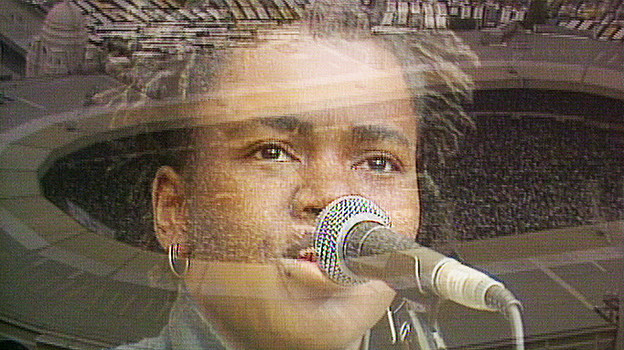
In 1988, the world was introduced to Tracy Chapman when she performed her song Fast Car for a massive crowd of 90,000 people at Wembley Stadium. The concert, which was a birthday tribute to Nelson Mandela, was broadcast to 600 million people around the world, elevating Chapman as an important new American voice.
Today, 35 years later, the story of that concert is legendary. Before getting drafted in as a last-minute replacement for Stevie Wonder, Chapman was a virtually unknown singer-songwriter whose background was in street performing. Though stepping out onstage at Wembley was a daunting experience, she credits her years spent busking on street corners for teaching her how to hold a crowd’s attention with just her voice and a guitar.
“I was clearly overwhelmed,” Chapman tells Q guest host Garvia Bailey in a rare interview. “It was the largest audience I’d ever been in front of…. Because I was solo acoustic — it was just me and the guitar — they realized they could slot me in at any point in the show. And so we were just waiting in the green room and then they came and said, ‘Look, you’re on.’ And that was it. There was no warning.”
Fast Car, the lead single off Chapman’s self-titled debut album, shot her to stardom and won her a Grammy. It not only changed her life, but the life of countless fans, like the British novelist Zadie Smith, who recently wrote about Chapman’s impact in a piece for The Guardian.
While some life-changing hits take years to write, Chapman says she wrote Fast Car in a single night in 1986.
“It was pretty late or early in the morning, maybe two or three in the morning,” she says. “I was up, I was playing [guitar], my dog was sitting next to me on the couch — a miniature dachshund, extremely important to the story — and I started playing that line on the guitar and came up with the first line of the song. It developed from there. I think I wrote most of the song that night and then I went back and revised it throughout the week. So in a way, it was quick. There’s some songs that take me years to finish, but that was not one.”
The full interview with Tracy Chapman is available on the podcast, Q with Tom Power. (Spotify – Apple Podcast)
Summary
The singer-songwriter Tracy Chapman made her voice heard in 1988 when she performed her song “Fast Car” for 90,000 people at a Free Nelson Mandela concert at Wembley Stadium. That song was off her self-titled debut album, which went on to win three Grammys and solidify her as an important American voice. Now, 35 years later, it’s still making an impact and it’s just been re-issued on vinyl. Tracy joins guest host Garvia Bailey to share her memories of making that record, why she thinks “Fast Car” means so much to so many, and how the years she spent busking on street corners taught her how to hold a crowd’s attention with just her voice and a guitar.
Episode’s Transcription
Tom Power: So picture this. It’s a sold out stadium. Crowds chanting, waiting for the next big act. Somebody comes out on stage, no one recognizes her. People keep talking, no one’s shutting up. And then she starts singing.
Do you hear that? Do you hear how the crowd was chanting at the beginning and yelling and screaming? And they just quieted down, that’s 90,000 people doing that, because that’s Tracy Chapman in 1988, singing Fast Car at Wembley Stadium for the Free Nelson Mandela Concert. The album that song is from, which was her self-titled debut album, sold over 6 million copies in the US alone. Over the course of her career, Tracy’s released seven more albums, won four Grammys.
She put out that great, remember that? “Give me one reason to stay here. I really like that song.”
Just last year, you might remember, she showed up at the Grammys and surprised everyone by singing “Fast Car” with Luke Combs, who had recorded that song and made it a hit again. Tracy Chapman became the first black songwriter to win Song of the Year at the Country Music Awards. Yeah, when I said that Tracy Chapman was going to be on the show, I was getting texts from people saying, “I can’t believe she’s going to be on. She’s my favorite.” That album means so much to so many people. Now, that album is being reissued on vinyl for its 35th anniversary.
Last week, our guest host Garvia Bailey got the chance to talk to Tracy Chapman in a rare interview about that album, about her career, and about her impact. Here’s their conversation.
Garvia Bailey: So a few days ago, I read this great article from Zadie Smith. She wrote a piece in The Guardian about being 12 years old and watching you on TV at Wembley Stadium. And she said “she didn’t just look like the people on our side of the screen, she was singing our songs.”. And I got to say that was exactly my experience, hearing you, seeing you for the first time. It was like my little black girl, teenage me, was given permission to take up space. What does it mean to you to hear that kind of thing from your fans?
Tracy Chapman: Oh, I’m really touched by it. And I was very deeply touched and moved by the Zadie Smith piece. It made me cry, honestly. And it’s interesting what you’ve just said, because what I felt when I read what she wrote is that she seemed to get me. And that’s really so special to feel like someone has seen you and heard you, or someone reflects yourself back to you. So it’s an interesting circle, this moment.
Garvia Bailey: Yeah, because she was saying that she felt that she was seen somehow, that the way that you explain it as a circle is exactly it. Can I ask you to take me back to that stage for a moment? I’m sure that everyone has asked you this, but I need to know. The crowd, they’re chanting, they’re restless. I can’t even imagine it. Like my heart was beating for you when I saw you step out onto the stage. And then your voice comes in. What do you remember about that moment? Can you take me there?
Tracy Chapman: I think some of the memories have faded, and also probably my level of nervousness may have made it so that some memories didn’t imprint at all. But as you can hear, it’s interesting hearing that clip, because you can hear the shakiness in my voice at the very beginning. So, you know, I was clearly overwhelmed, and that’s what I mostly remember feeling, is just pretty overwhelmed by it all. It was the largest audience I’d ever been in front of, having come from street performing, busking in Cambridge and Harvard Square, and playing folk clubs at the universities in Boston. And for small crowds or audiences, you know, 100 to maybe a few thousand people. So that was a major leap.
And then that moment, I had been rushed to the stage because, and I still don’t really know why I was invited to be there for that show. I mean, it was greatly honored. I really believed in Nelson Mandela and everything that he was fighting for. So to be a part of that was just an incredible honor. But I don’t really know how they even discovered me to say, yeah, you should be here. But because I was solo acoustic, it was just me and the guitar. They realized they could slot me in at any point in the show. And so we were just waiting in the green room. And then they came and said, “Look, you’re on.”. And that was it. There was no warning. And we literally ran to the stage. I think my guitar chord was trailing behind me. And in a way, it may have been the best way to get me out there. I sort of shoved out there. Because just walking straight on to that stage without having a built-in audience, anyone who knew me, anyone who knew the songs, except for the people backstage with me. It was a pretty daunting moment.
I sometimes think, and this might sound kind of silly, but that the street performing that I did may have been a little bit of preparation for that moment because when you’re street performing, you’re trying to grab the attention of people who have someplace else to be. I was always playing original songs when I busked on the street. So there was music that wasn’t familiar. So I think sometimes just looking back that that might have served me in that moment to calm my nerves just a little bit so that I was able to get started on the song and make it through.
Garvia Bailey: Did you sense that you had the crowd? Was there any moment in that time where you were like, oh, they’re actually really listening to me?
Tracy Chapman: I think I did. I think you can see it if I’m remembering it correctly. If you see my face at the end, because I do smile, and it was probably a smile of relief as much as anything. But yeah, I think at some point I realized, okay, they’re actually paying attention. It was just amazing.
Garvia Bailey: I think it’s a testament to the just the incredible songwriting and of course, your performance. But I want to ask you about “Fast Car” and writing the song itself. And I understand that there was a narrative that you were going for, but I wonder how it came to you.
Tracy Chapman: This is what I remember. And to this day, I play guitar, I practice, I’m still writing songs. You know, I’ve been doing this since I was eight years old. So it’s a natural constant endeavor in my life. I remember that this one night and it was pretty late or early in the morning, maybe two or three in the morning, I was up, I was playing. My dog was sitting next to me on the couch, a miniature doxin. It’s extremely important to the story.
Garvia Bailey: Perfect, perfect dog for this story.
Tracy Chapman: Yeah, and I started playing that line on the guitar and came up with the first line of the song. And then it developed from there. And I think I wrote most of the song that night. And then I went back and revised it, I think, throughout the week. And so in a way that when it was quick, I mean, there’s some songs that takes me years to finish, but that was not one.
Garvia Bailey: I’m going to come back to that album in a moment, but I want to just jump back just a little bit to Cleveland again about your draw to the stage, because, you know, not everyone wants to perform, but at some stage, you needed to share what you were doing with people.
Tracy Chapman: My sister is my biggest champion, and she’s also my first listener. So when I started writing songs at eight years old, I probably tormented her by insisting that she had to listen to me. And she did me the great courtesy and favor of always telling me the truth and saying, “Aw no, that one’s not good” or “You need to keep working on it” or “Try something else“. And so, you know, I had an audience of one for a very long time. And then my friends, when they heard that I was playing guitar and writing songs, they at least politely seemed to be interested. I think my first public performance on guitar was at a Boys and Girls Club in Cleveland and I played Supercalifragilisticexpialidocious just as a musical piece.
Garvia Bailey: Right. As you should.
Tracy Chapman: Absolutely. I mean, it’s obvious that that’s where it all started. That’s right.
Garvia Bailey: And you’re like, that’s it. I need to do this.
Tracy Chapman: Absolutely. Yeah. So it wasn’t as much about the performing aspect of it for me at first, because one, I didn’t have any place to play. It was really about the creative aspect of making something and writing songs. I’d always loved poetry and I’d been drawn to playing various instruments since the time I was very young. And so putting those two things together and writing songs, playing guitar is just the perfect combination for me. And I didn’t really then start to perform until I got to high school. I received a scholarship to a private boarding school in Danbury, Connecticut, a place called the Wooster School. And it was there that I met other kids who played acoustic guitars. And some of them, I think, also were writing songs. And so we would play together. And then I joined the coffee house committee and we were supposed to book people for the shows, but we never could. And so we would play them ourselves.
Garvia Bailey: Right.
Tracy Chapman: And so it all just started that way. Little things here and there. I had a brief stint where a friend and I, we went, we took the train to New York and we set up our guitars in front of the public library and made no money, and returned back to school on the train. So that’s how it all started. And then actually the first time I street performed in Harvard Square was because I was at school for a holiday. None of us had any money and we wanted Chinese food. And one of my friends suggested that if I went into Harvard Square that maybe we could make some money.
Garvia Bailey: You could make some money, of course.
Tracy Chapman: And it worked. I think I made $30
Garvia Bailey: Nice!
Tracy Chapman: And bought this all Chinese food and there you go
Tom Power: I’m Tom Power, you’re listening to Q. You’re in the middle of guest host Garvia Bailey’s conversation with the singer-songwriter Tracy Chapman, and they were just talking about Tracy’s early days, you know, on the street as a busker, as a performer. What’s interesting is not just that Tracy’s self-titled record, like, shot to the top of the charts and kind of changed the game for singer-songwriters. What’s also interesting is the landscape that record was put out into. Like, the biggest hits at the time were Need You Tonight by NXS, or I Wanna Dance With Somebody by Whitney Houston. It was not a great time for solo singer-songwriters with acoustic guitars. So Garvia asked Tracy, how did she think about all that? Here’s what she said.
Tracy Chapman: I think the answer is I didn’t. I didn’t think about it. I had very modest goals as it relates to my music career. It’s hard for me now to remember exactly what was going on in the charts then. But I certainly knew that the kind of music I was making as a solo acoustic artist, that wasn’t what was popular. So when I was signed by Bob Krasnow to Elektra Records, one, it actually felt like it was a good fit for me because it was a label that had a history with singer-songwriters. He never attempted to change anything about what I was doing. It was the same with David Kershenbaum who produced the record that when we met and I played the songs for him and he heard the demo tape, his instinct wasn’t, “okay, we’ll try to make this sound so that it fits with radio, what you’re hearing now”. His instinct was, “let’s build on what you’ve already made here and let’s just embellish it, but keep you at the core of it”. And so I was lucky, I think, that there wasn’t anyone who was in a position of power, who wanted to change what I was doing. I just thought, this is great. I have a record deal right out of college. I’ll make enough money that I can support myself. That was my dream at that point. I had no idea that things would go the way they did and get as big as it did.
Garvia Bailey: So pragmatic. You’re a very pragmatic young person.
Tracy Chapman: I’m a midwesterner.
Garvia Bailey: That’s what you do.
Tracy Chapman: Exactly.
Garvia Bailey: I want to just play a little bit of the first track because what a way to open an album. Just listen to yourself for a minute, Tracy. (…)
Man, what a way to start an album. The unmistakable voice of Tracy Chapman. Tracy is with me chatting about the debut album. Do you remember writing that one? To be singing about revolution? Man, oh man, that hit me hard when I heard it for the first time. Tell me about writing, Talkin’bout a Revolution.
Tracy Chapman: Well, I can’t say I remember it exactly because I was 16 years old when I wrote that song.
Garvia Bailey: You wrote that song at 16?
Tracy Chapman: Yes.
Garvia Bailey: Amazing.
Tracy Chapman: But the thing that I recall, I believe that it was inspired in part because it was around that time that I received the scholarship to the private school in Connecticut. And it was really an amazing opportunity. And they took great care of me there. And I think having that opportunity saved my life in a lot of ways. But it was also some serious culture shock for me. In that I grew up working class in Cleveland, Ohio. And my sister and I, we were raised by my mother after my parents divorced. You know, everyone I knew in my family, they all worked in, you know, the industrial manufacturing economy in Cleveland, which was failing at that time. You know, the car plants and the rubber plants and the steel mills, people were losing jobs. And so even though my mother tried to shield me and my sister from, you know, the stress of some of that atmosphere, you still pick up on it as a kid.
And then I was thrust into this new environment where it was the total opposite. And the kids at the school, some who became friends of mine, years, you know, even years later, they were totally unaware of the kind of experience that I’d had, what it was like for me growing up. And so I think I wrote that song in part as a way to explain, like, where I was coming from.
Garvia Bailey: You said, you know, that that school experience, it saved your life. And what was it about it, about your life that needed to be saved in that moment?
Tracy Chapman: Well, I think I’ve talked about this before, but maybe not in too much detail. Most of the songs on the record, this record, they’re not specifically autobiographical. But one song is, and that song is “Across The Lines”. And the little black girl is me. In the 70s in Cleveland, it was a pretty volatile place. There was a lot of racial tension, and some of that was because the court had ordered the public schools be desegregated, and there was quite a bit of opposition to that. And so often, I wasn’t even in school, none of my friends were, because there was just too much chaos. But it was a challenging time, and unfortunately, during that time, I was assaulted while I was leaving school by a group of white kids. And the older white guy in the group, he pulled a gun on me.
Garvia Bailey: What?
Tracy Chapman: Yeah, and my friends who were with me, of course, scattered, but I would have scattered too. But anyway, we tussled, we fought and broke away from him. And I think his girlfriend or something said, just “Leave her alone”. And also, I don’t think he expected me to fight back. But anyway, that story, the news was actually printed in the paper. And the riots that I talk about in the song, I mean, I didn’t write this song till much, so much… I was in college when I finally wrote something about it. But in that way, getting that scholarship, my mother didn’t want me to go away to school. She thought I was too young. But I think after that, she thought, oh, this will be better. This will be safer for you.
Garvia Bailey: I think that telling that story and all the songs on the album, it’s starting to all make sense to me right now, why your music had such a profound impact on so many. I think there’s something to be said about truth and authenticity, and especially at that time, getting to hear someone’s truth like that was very, very powerful.
And Zadie wrote about it, I think about it all the time, millions are thinking about you and your music right now, you know, it hitting the charts, Song of the Year, the Country Music Awards for Fast Car. When you think about the impact you’ve had on so many people, what are you most proud of?
Tracy Chapman: Well, I guess I’m generally just proud of the fact that I was given this opportunity to have a public forum for my creative expression. And I’ve always just tried to be true to that. I was very fortunate that at the beginning, there was no one who tried to pressure me to be anything but myself. I mean, that’s obviously what I wanted, but it also was the only thing that seemed to make sense to me is that here I have this chance to do this thing I love so much, that if I don’t do it the way that feels right to me, it doesn’t make any sense at all. And so I’ve just held on to that through the years. And I think maybe it’s been that my records aren’t as popular as some records might be. But I’ve tried to be true to the creative inspiration and expression. And so I’m really proud of that. Sort of keeping that foremost in my mind and not being distracted. You know, there’s so much in this business that can distract you from, for me, what matters, which is making music and, you know, trying to offer something that you think is worthwhile.
Garvia Bailey:Yeah. Well, you’ve certainly done that, Tracy Chapman. It’s been such an honor and a pleasure talking to you. Thank you for taking the time. And I’m so looking forward to the new vinyl. How exciting.
Tracy Chapman: It’s been a pleasure talking to you too. I really, really appreciate it.
Tom Power: That is Tracy Chapman, and one of the perfect songs. We got a few of them out there, and that’s one of them. One of the perfect songs, that’s Fast Car. Man, I love that song. Guest host Garvia Bailey spoke with Tracy Chapman. Her first album, called just Tracy Chapman, came out 35 years ago. It’s just been reissued on vinyl. That is it for Q Today.”