

Tracy Chapman, Tracy Chapman debut album release in 1988, has been chosen by the Library of Congress for preservation in the National Recording Registry.
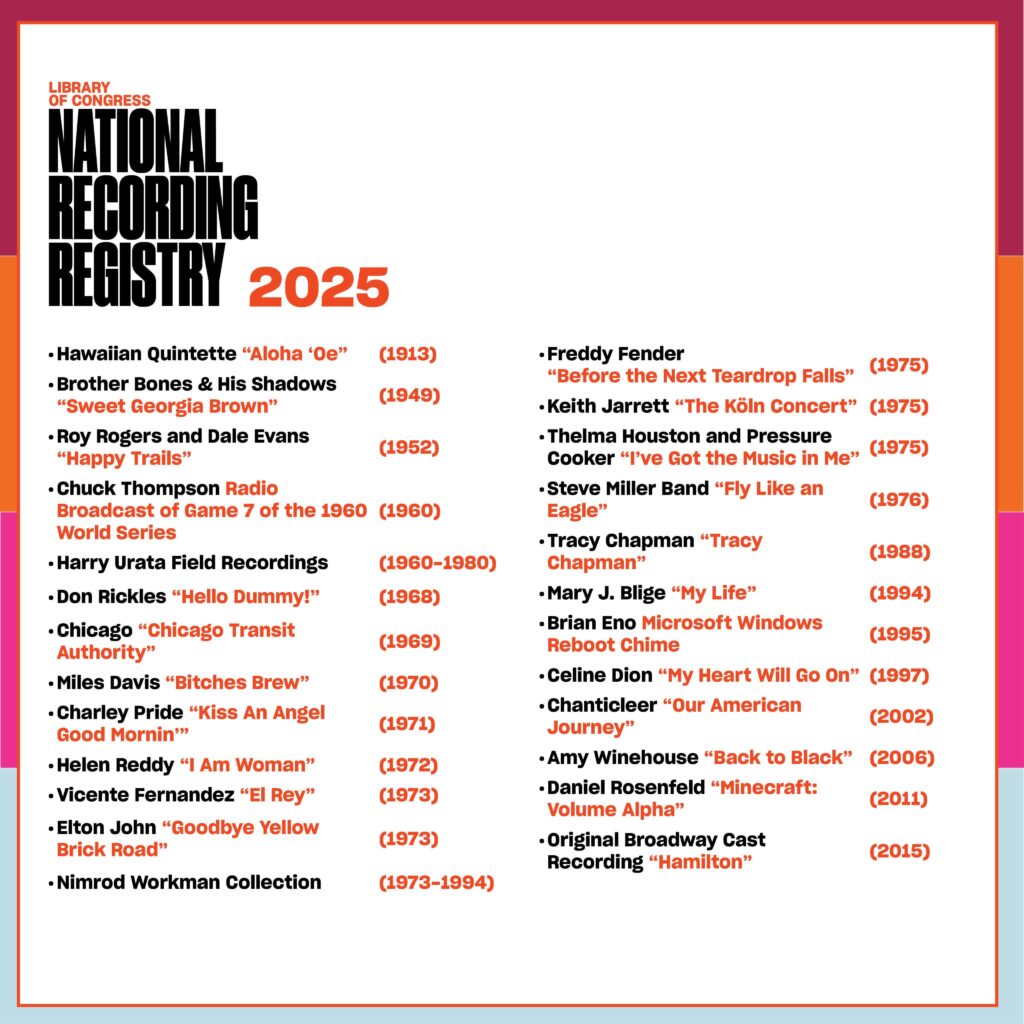
In total 25 recordings have been chosen this year “based on their cultural, historical or aesthetic importance in the nation’s recorded sound heritage.”
Other albums picked include Elton’s Goodbye Yellow Brick Road, which features hits like the title track, “Bennie and the Jets” and “Candle in the Wind”; Chicago’s debut Chicago Transit Authority, with songs like “Does Anybody Really Know What Time It Is?” and “Questions 67 and 68”; and Steve Miller Band’s Fly Like an Eagle, with hits like the title track, “Take the Money and Run” and “Rock’n Me.”
Songs chosen include Celine Dion’s Titanic hit “My Heart Will Go On,” and “I Am Woman” by Helen Reddy, with the Microsoft Windows Reboot Chime, composed by Rock & Roll Hall of Famer Brian Eno in 1995, also getting in.
“These are the sounds of America – our wide-ranging history and culture. The National Recording Registry is our evolving nation’s playlist,” Librarian of Congress Carla Hayden said. “The Library of Congress is proud and honored to select these audio treasures worthy of preservation, including iconic music across a variety of genres, field recordings, sports history and even the sounds of our daily lives with technology.”
The public can nominate recordings to be considered; this year, the Library of Congress received 2,600 nominations, with Chicago Transit Authority being the top nominee. With the new additions, the National Recording Registry titles are now at 675, part of a recorded sound collection of close to 4 million items.
Tracy Chapman was interviewed for the occasion and the interview received an airing on NPR/WAMU’s 1A programme today as part of its The Sounds of America radio series. You can listen to it here.
Here are some excerpts:
Tracy Chapman on Starting in Music and the Importance of Preservation
“For me, actually, my interest in music started when I was very young. I started writing songs when I was 8-years-old, and I started playing guitar at that time as well. I grew up in a very musical household. My mom sings, and my sister has a lovely voice. There was always music all the time, either the record player was on or my mother was singing to gospel music on Sundays. And I just had an interest in acoustic guitar, I think, in part, because I saw a country music program called ‘Hee Haw’ and really loved the guitars and begged my mom to get one for me. So that was the beginning of my songwriting. … I played clarinet, I played ukelele – I think that was actually the first instrument that I played. And then I played classical clarinet when I was in school, I studied that. But the guitar was something that I just was so drawn to. Because I also had written poetry when I was a kid – and so this combination of my interest in poetry and my interest in music, it all culminated in me, in a way, becoming a singer/songwriter at a very early age. And so by the time I got to Boston in the ’80s, I’d already been writing songs – I’d written hundreds of songs – and I’d also even been playing for people,” Chapman said.
“When I was thinking about this question about why people should care about recording preservation, it reminded me that I studied anthropology, and I have a bachelor’s degree in sociocultural anthropology,” Chapman said. “This is just the sort of thing that, had I gone on to study and work as an anthropologist that I would have loved to have available. These are the things that anthropologists dream of because it tells you so much about how people live. You not only learn about what entertains them, about maybe what’s considered current or culturally relevant at a certain time, but you also get a glimpse into the things that matter to them. And that’s the stuff that you go digging for and that you hope you’ll find somewhere when you’re on the path of studying people and how they live. … And lastly, I would say too, I basically grew up in a public library. I lived across the street from one. It was the only place my mother would let me go on my own. And so, I love libraries, and I love books and archives, and so it’s really so amazingly awesome to be part of one of the most important libraries in the world, I’d say, but certainly in the United States.”
Tracy Chapman on Songwriting and writing “Fast Car”
“For that song, for “Fast Car,” I was up lead at night, which I often am when I write songs. No one else was up except my miniature Dachshund, who was sitting on the couch next to me. And I, as I recall, I just started playing the melody for the guitar part. And then right away, the first line of the song also came to mind. And then with a song like that, there’s just a lot of questions. And this happens for me most of the time, actually, when I’m writing. It’s, in a way, a process of answering questions and sometimes solving problems or filling out characters. So once I had that first line, “You’ve got a fast car,” the question is, “Who is you?” And then, “What’s the car all about?” And then it keeps going from there. And with that song, with “Fast Car,” I think I wrote most of it in that one night, or early morning, I guess it really was. And then over, I don’t know how much time, I edited the song or revised a few things or fixed, honestly, a few things. I definitely, I look back and I know I had a few clunker lines in there or something that either I didn’t feel was right in terms of the rhyme or in terms of the expression.
So, and I guess that kind of sums up the way I write most of the time. I’m not sure this is interesting to anyone, but I also, I always record when I’m writing. And I also write things down by hand in notebooks. And that’s a really important part of the process, the recording especially, because what I discovered is that often the very first thing that comes to you is unfiltered. It’s, and especially I think in my case when I’m writing at like two or three in the morning, there’s a way in which your mind is free. And there are few distractions at that hour. And so there’s a way in which there’s the unconscious part that isn’t making standard associations, then there’s a part of your mind that I think is more available. And so if you don’t capture whatever that is right away, it can go away. And the other part of the songwriting process for me involves a lot of repetition. So once I have something that I like, I just keep playing it over and over. I mean, I probably played Fast Car and every other song that I’ve written hundreds of times before anyone else has ever heard it, either in its development or once it’s complete. But once you start doing those repetitions, you can then fall into the habit of doing things in a standard way. But those early moments of the process, those are the moments that I find most interesting and that I find are most fruitful because you are starting with something that’s coming from an unfiltered place.”
